

Please refer to your Biology Book for the experiment and what you need to do. This part of the site is just set-up to let you know the status of what we have available at our store for the experiment and where you may be able to locate other items that we don't have or do not stock.
This experiment is designed to make you more aware of the components involved in an aquatic environment . By creating a habitat in the bottle and observing it over a period of time is a good hands on learning experience.
Goal: Students will develop an understanding and gain knowledge about aquatic ecosystems
Objectives: Create a journal or take notes consisting of observation notes concerning their aquatic creatures and plants. List necessary items to complete an aquatic ecosystem. This experiment will make the students aware of how important habitats are for certain species. By using hands-on activities, such as creating an aquatic ecosystem, they will observe and monitor the processes as they occur.
Materials: A few Two liter bottles of pop (empty), water, marker, scissors, tape, and a hole puncher and Aquatic life (see below: snails, guppies, plant life, and gravel or sand)
 Common Guppy 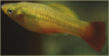 Variatus Platy |
Common Guppies (Call for Price & Availability) Variatus Platies (Limited Stock) We usually carry a small selection "Pet Common Guppies" and "Pet Variatus Platies" We are also have limited supply of Fancy Guppies and we do have other Platies available. We also have Feeder Guppies but they are VERY small in size at the moment. They can be used for this experiment. |
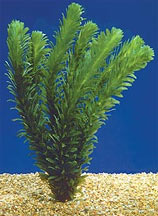 |
Anacharis Live Plant -(Call for Price & Availability)
You need a piece of this Live Plant (also known as Elodea). We normally sell it in bunches or 4-8 pieces so make sure you let us know you are using it for the experiment so we can just sell you 1 piece or two. |
 |
Duckweed Live Plant -(Call for Price & Availability)
This a very small floating plant that will grow at the top of the bottle.We have plenty of it in stock and available. |
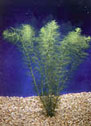 |
Foxtail Live Plant - (Currently Out of Stock)
This plant comes in a green and a red variety and sometimes can be used instead of the Anacharis Elodea Live Plant. |
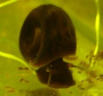 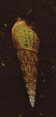 |
Ramshorn or Mylasian Snail - (Call for Availability)
This is a small snail perfect for a small pop bottle ecosystem that is about the size of a green pea. Word is that some of our competitors are selling Mystery Snails for the project. These are usually to big and over crowd the bottle causing problems. We have some in stock but most of the larger ones have been sold but smaller ones are available. Malaysian Snails (another small snail) are also ok for the experiment. |
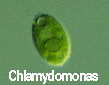 |
Chlamydomonas Algae - Good Luck... :- )
We have a tank that is covered with Algae but it may not be the right type. Chlamydomonas is usually a free floating algae. You may have to go to Palmer Park, Rouge Park, or Belle Isle and find some slimey green water in one of the canals. We have sold some students some Algae covered gravel hoping to seed the Ecosystem but this may not be what your teacher wants. Look for a follow up post on this. More info on this type of Algae and Culture can be found here: Information about getting a cultures can be found here: |
|
|
Feeder Guppies .15¢ each (in Stock) Platies (Call for Price & Availability) We have good healthy stock of Feeder Guppies but they are VERY small in size at the moment (see common guppies below) that can be used for this experiment. They are small in size and usually will do better in smaller containers than the ones that are sold as pets. We just got a shipment of "Pet Common Guppies" and "Pet Variatus Platies" as well as Fancy Guppies and other Platies available. |
 |
Fontinalis antipyretica -Out of Stock Common Name: WILLOW MOSS Try Java Moss (below) as a substitute. |
 |
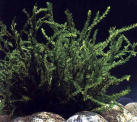
Java Moss, (Fontanalis substitute)
A very similar plant to Willow Moss that grows the same way. |
 |
HBH Fry Bites (In Stock, $2.79) |
1. Cut off the top of one bottle and the bottom of another.
2. Using the bottom piece, cut some holes in it for proper ventilation of air (this will be used as our lid).
3. Before adding the water, add about an inch or two of sand or gravel
4. Add water to the bottle (make sure temperature is correct).
5. Add the plant life (elodea, and duckweed), but be sure to secure Elodea plants in the sand or gravel.
6. Add the rest of the aquatic life: *one male and one femle guppy and one or two snails
7. Secure the lid and put a piece of tape on the bottle.
8. Store in a safe place and check it twice a week noting any changes or differences that occur.
More detailed info on experiment can be found on these links:
http://edutel.musenet.org:8042/pondwatch/pondwatch_lesson1.html
Or use the Search Box below: